In case of the mileage of a car or a bike - we calculate the distance travelled in a litre of gas. Which gives us a figure in kilometers (or miles) per litre ( ). It becomes particularly useful metric to plan long distance travel. It helps us decide where to fuel up and how much fuel to carry.
The same has to be estimated in case of rockets. Fuel carries weight, rockets require lots of fuel, and there’s only one gas station. Hence this metric becomes pretty important to be calculated accurately.
However, unlike mileage where we measure distance covered per unit of fuel, in case of rocket propulsion the “distance” becomes “total thrust generated over time aka Impulse”.
The car mileage could have been measured in something like total torque generated per litre of fuel - however that won’t be very useful context to plan our trips.
Dimensionality of Specific Impulse
Thrust is total force exerted over a linear direction - and the fundamental principle behind Thrust is the Newton’s Third Law that if you push something, the something pushes you back in the opposite direction.
When we integrate force across the time the fuel is burning, we get what is called
Further when we measure Impulse per unit weight of propellant (like how we measured ‘per litre’ in case of car mileage) - we get Specific Impulse ( ).
Specific Impulse ( ) is the thrust generated by a unit weight of propellant over the entire time it burns.
So mathematically, what we have is, force is mass times acceleration and weight is mass times gravitational pull, this gives us, acceleration of rocket () and the gravitational pull (), while the values being different, are dimensionally the same measurements. Hence what dimensionally remains is time (). Thus Specific Impulse is always defined in . Note: A dimensional analysis only defines the unit, do not confuse this as specific impulse equals elapsed time.
Factors that define Specific Impulse
Specific Impulse at core is a unit of efficiency. A rocket propulsion system having high specific impulse would hence always be preferable.
However, achieving this high specific impulse depends on the Engine Design as well as the Propellants used. Hence it is a system quantity.
To identify the factors that define this Specific Impulse would require us to explore the other equations of specific impulse.
The Force Components in Rocket Propulsion
We mentioned Newton’s third law above, leading to thrust acting rearwards and propelling the rocket up. That’s the major component called Momentum Thrust.
The other component is Pressure Thrust. Pressure thrust occurs whenever there is a pressure differential. High pressure zones will push into low pressure zones to gain stability. And they act in all directions, normal to the contact surfaces. Imagine blowing up a balloon, it expands equally in all directions because the pressure applies on all faces equally and perpendicular to the surface.
A similar effect happens in rocket propulsion. Due to pressure differential within the chamber, nozzle and at the nozzle exit, a normal pressure would be exerted on the chamber walls, nozzle walls, and finally the exit cross-section of the nozzle.
The below image attempts visualising Pressure Thrust,
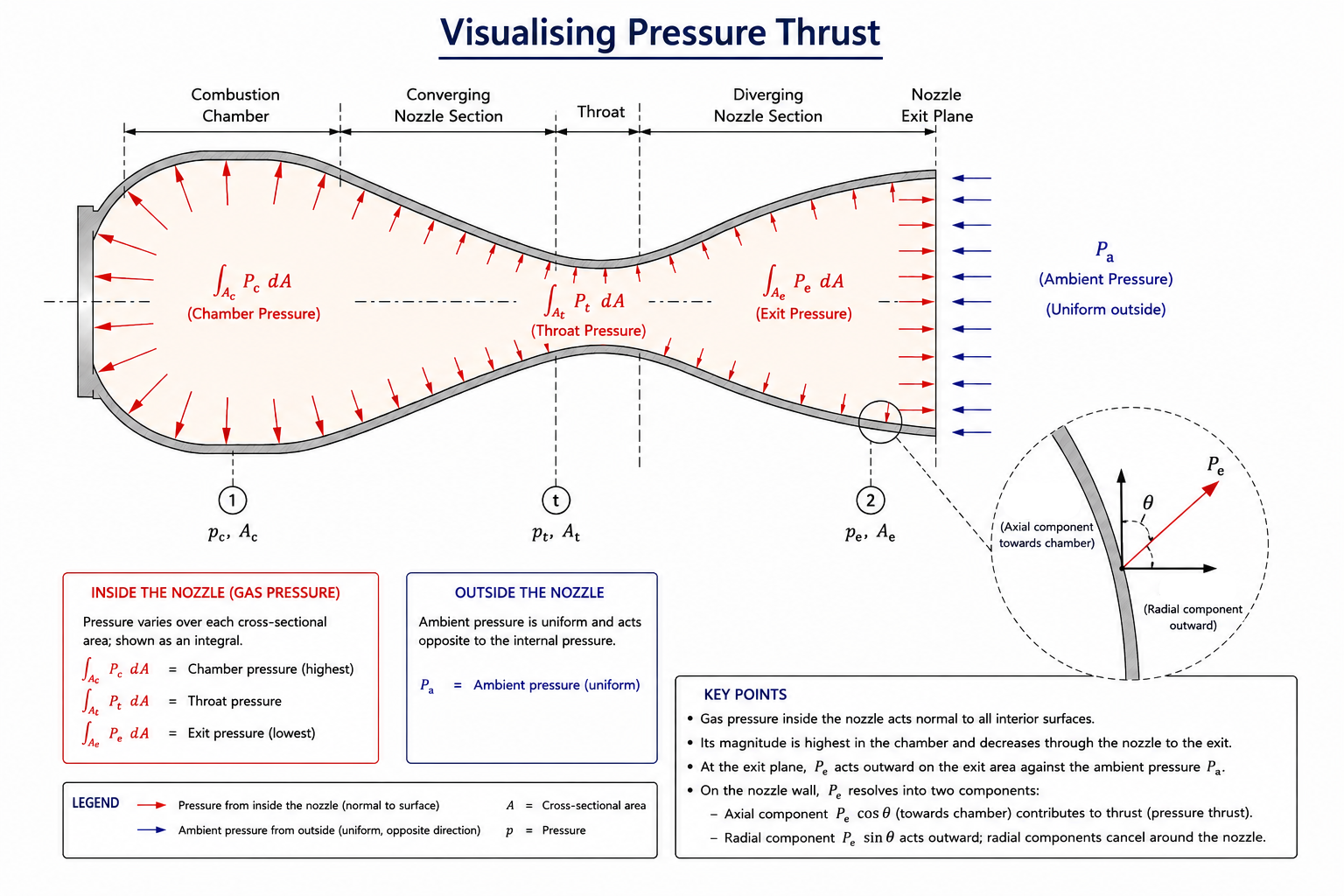
- The Radial components of pressure acting on the nozzle wall and chamber walls cancel each other out due to the axial symmetry of the engine.
- The Axial components contribute to the lift-off of the rocket and are considered within the Pressure Thrust components.
- The exit pressure on nozzle exit cross-section is however the most prominent and shows up as a component in the Rocket Thrust equation below. The minor axial forces above are considered in the Pressure Thrust component of that equation.
- Momentum thrust contributes the majority of rocket propulsion thrust. As the rocket goes into a vacuum environment the component becomes close to zero - hence in this case the adds more prominently to the thrust compared to at sea level.
- At Sea Level the nozzle cross-section has to be designed to achieve at the farthest tip of the nozzle. In case at the farthest tip of the nozzle, we lose the pressure thrust that could have been captured. If the external air rushes into the nozzle causing instability.
Adding up the Momentum Thrust and Pressure Thrust, hence we get the following Rocket Thrust equation, and a simplified version of this gives us an Effective Exhaust Velocity,
| Symbol | Definition | Standard Unit |
|---|---|---|
| Total thrust force | ||
| Propellant mass flow rate | ||
| Physical gas velocity at nozzle exit | ||
| Exhaust gas pressure at nozzle exit | ||
| Ambient atmospheric pressure | ||
| Cross-sectional area of nozzle exit | ||
| Effective exhaust velocity |
Specific Impulse in terms of Exhaust Velocity
Since we have exhaust velocity in terms of Force and Mass Flow Rate. Based on our initial force equation of specific impulse, we get,
| Symbol | Definition | Standard Unit |
|---|---|---|
| Specific impulse | ||
| Total thrust force | ||
| Propellant weight flow rate | ||
| Propellant mass flow rate | ||
| Standard gravitational acceleration () |
Based on this equation what we can confirm is that Specific Impulse directly depends on Effective Exhaust Velocity.
Higher means higher specific impulse of our propulsion system.
To identify the actual factors that impact and hence , we need to study another relation.
Thermodynamic Nozzle Equation
Remember how we consolidated earlier for simplicity. That same Effective Exhaust Velocity derives itself to below mentioned equation:
| Symbol | Definition | Standard Unit |
|---|---|---|
| Ratio of specific heats () | Dimensionless | |
| Universal gas constant () | ||
| Combustion chamber temperature | ||
| Average molecular weight of exhaust gases | ||
| Nozzle exit pressure | ||
| Combustion chamber pressure |
How to Maximise Rocket Propulsion Efficiency
Now coming to the actual factors - we can see that, to improve specific impulse of a system we need to:
-
Increase Combustion Temperature () Propellant and Engine Characteristic
Fuel and oxidisers that combine to generate high chamber temperature result in higher thermal kinetic energy that can be then expanded through nozzle to achieve higher exhaust velocities.
However, high temperatures have to be balanced with adequate cooling systems. Hence we need quality materials for the chamber as well.
-
Increase Chamber Pressure () Engine Characteristic
Chamber pressure has to be higher than the Nozzle Exit Pressure for the combusted material to exit. The lower the ratio, higher the exit velocity.
This ends up being an Engine Characteristic because propellants have to be pressurised using turbopumps before they lead into the combustion chamber.
-
Decrease Average Molecular Mass of the exhaust gas () Propellant Characteristic
Lighter molecules expand faster leading to higher exhaust velocities. Note that we are considering the molecular mass of exhaust material and not the fuel or oxidiser specifically.
Hydrogen rich fuel and fuel rich combustion is used to achieve this. Unburnt hydrogen is just 2 g/mol which can reduce the average molecular mass of the exhaust even when other exhaust compounds are heavier than the fuel.
-
Decrease the Nozzle Exit Pressure () Engine Characteristic
Leads to the decreasing pressure ratio. This is done by expanding the nozzle bell cross section area.
The pressure thrust component acts normally on the nozzle surface hence acting on the structure to push it upwards. The exit pressure should be high enough to avoid the ambient air rushing into the nozzle - that would lead to neither pressure thrust nor momentum thrust gain.
Once the nozzle ends, the exit pressure should match the ambient pressure. If the nozzle is not well expanded, we would observe the exhaust plume flushing outwards from the nozzle edge - this leads to loss of momentum thrust.
-
Specific Heat () Propellant Characteristic
Mathematically lower values will lead to higher exhaust velocities. This factor depends on the molecular structure of the exhaust gas and hence indirectly depends on the propellants, environment in which combustion occurs and the quality of combustion.
The above factors are the core elements that are manipulated to design better propulsion systems. However sometimes, we do look at the larger picture - for instance Hydrogen is less dense and has to be stored at , thus requires extra hardware infrastructure to insulate it from oxidiser and requires larger tanks.
Hence switching liquid hydrogen with methane as fuel reduces the tank size and the separation infrastructure between fuel and oxidiser. However methane leads to sooting problem at higher temperature combustions and also it leads to the average molecular mass of exhaust doubling compared to hydrogen as fuel. This impacts the Specific Impulse - to balance this out further new innovations have to be made, like how the Raptor engine increases the chamber pressure to about 300 bar.
Specifications of Modern Engines
CE20 is only designed for vacuum and thus has very low nozzle exit pressures. The RS-25 however is designed for sea-level operation as well and still uses a low exit pressures, the nozzles of RS-25 are specially designed to avoid ambient air rushing in and causing vibrations.
RS-25 is designed this way as it spends majority of its flight trajectory in vacuum.
| Rocket Engine | Propellants | Specific Impulse () | Chamber Temperature | Chamber Pressure | Nozzle Exit Pressure |
|---|---|---|---|---|---|
| CE20 (ISRO) Vacuum Engine | LOX / LH2 (Liquid Oxygen / Liquid Hydrogen) | ~443 sec (Vacuum) | ~3,000 K to 3,300 K | 6.0 MPa (~60 bar) | ~0.04 bar to 0.08 bar (Highly expanded vacuum nozzle) |
| Vikas (ISRO) | UH25 or UDMH / (Hypergolic) | ~262 sec (Sea Level) ~293 sec (Vacuum) | ~3,200 K | 5.85 MPa (~58.5 bar) | ~0.4 bar to 0.5 bar (Slightly under-expanded at sea level) |
| Raptor 3 (SpaceX) | LOX / LCH4 (Liquid Oxygen / Liquid Methane) | ~327 sec (Sea Level) ~350 sec (Vacuum) | ~3,600 K | 33.0 MPa (~330 bar) | ~0.6 bar to 0.8 bar (Sea-level version) |
| Aerojet Rocketdyne RS-25 (NASA) | LOX / LH2 (Liquid Oxygen / Liquid Hydrogen) | ~366 sec (Sea Level) ~452 sec (Vacuum) | ~3,570 K | 20.6 MPa (~206.4 bar) | ~0.15 bar to 0.2 bar (Optimized for high-altitude/sustained ascent) |
| Merlin 1D (SpaceX) | LOX / RP-1 (Liquid Oxygen / Rocket-grade Kerosene) | ~282 sec (Sea Level) ~311 sec (Vacuum) | ~3,500 K | 9.7 MPa (~97 bar) | ~0.7 bar (Optimized for sea-level liftoff and landing burns) |
| RD-180 (Roscosmos / ULA) | LOX / RP-1 (Liquid Oxygen / Rocket-grade Kerosene) | ~311 sec (Sea Level) ~338 sec (Vacuum) | ~3,650 K | 25.7 MPa (~257 bar) | ~0.6 bar (Sea-level booster variant) |
Specific Impulse outside Rocket Propulsion
The core use of Specific Impulse is limited to rocket propulsion. However, the inverse of Specific Impulse , called as Thrust Specific Fuel Consumption (TSFC) is used to calculate Jet Propulsion efficiencies.
The core difference between Jet Propulsion and Rocket Propulsion is that, rockets have to carry their oxidisers while jet engines source air in-flight from the atmosphere. The Specific Impulse equivalents for jet engines are thus in thousands of seconds (atleast 10x chemical propulsion in rocket engines).